Camry / P0171
PCV hose recommendation
 Find the cause. Skip the guesswork.
For shop owners & service managers
DiagLogic AI is a chat-based diagnostic assistant for automotive technicians. Meet the Foreman: guidance through one test at a time, with the findings kept in view.
Not just a code
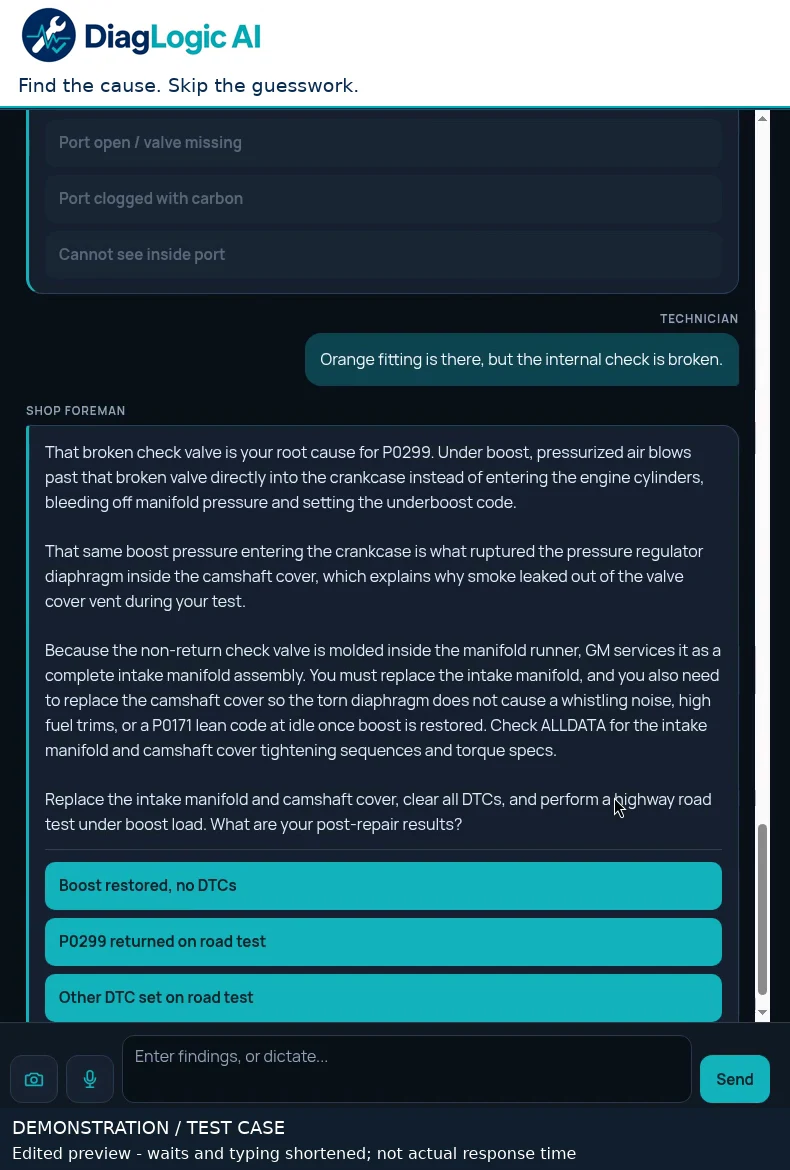
In this Cruze demonstration, P0299 leads through reported findings to an intake manifold and camshaft cover recommendation—not straight to a turbo.
Standard monthly plans
1–4 tech logins: $139.95 USD per store per month. 5–8 tech logins: $159.95 USD per store per month. Taxes are extra.
Read standard pricing, chain discounts and buying terms →No account or email is needed to read it.
PCV hose recommendation
Ground connection + retest
Ignition coil recommendation
Manifold + camshaft cover
Edited, simulated demonstrations—not customer repairs. Recommendations shown; physical repairs are not verified. No accuracy or outcome guarantee is implied.
Real shop cases
From the concern in the bay to the checks and the repair.
Shop-reported outcome
Shop-reported outcome
These real-case outcomes were reported by the shop, not independently or OEM verified. They are distinct from the simulated demonstrations above.
How it works
A clear path through the conversation. The technician performs the tests and owns the repair.
Enter the vehicle information, symptom and any codes. Give the Foreman the concern you need to work through.
Enter findings and follow the next check. Techs who prefer Spanish can use Spanish in the diagnostic conversation.
Use the recommendation alongside professional judgment and appropriate service information. Confirm the result after the repair.
Useful reading
Real shop cases and edited simulations, clearly labeled. Case-led reading—not universal repair recipes.
Real shop case
Follow the Sierra’s sensor checks, replacement and shop-confirmed return to full power with zero DTCs.
Real shop case
Separate the reported concern, guided checks and subsequent RAM repair report.
Simulated test case
Follow the Cruze example to its final recommendation—not a completed repair.
Simulated test case
See why the Silverado example ends with connection cleaning and a retest recommendation.